Plastic and social comparison
An IoT app to optimize users sleep environment and sleep routine for a quality sleep.
My role
I conducted a participatory design study investigating peer influence and plastic use to find a change in participants’ plastic usage by sharing plastic photographs in the Imessage group chat whenever they used certain types of single-use plastic. The qualitative data were collected in Google form for five days. In the context of the study, the results showed that participants' plastic use hadn't changed significantly even though they reported this project affects more feelings of guilt and decision making to use single-use plastics.
Tools
Sketch
Google Spreadsheet
Google Forms
Miro
Duration
2022. 06 - 07
Project Type
In class project ( Human Information Interaction at Pratt Institute School of Information)
Advisor
Irene Lopatovska
PROBLEM
RESEARCH GOALS
2. explore how people would feel and react when they find they use more plastic than their peers
1. explore how social comparison
motivate people to maintain their positive statue
(reduce plastic use)
INITIAL HYPOTHESIS
I hypothesize that social comparison may help people's desire to reduce plastic use.
LITERATURE REVIEW
Peer social comparison information can influence self-perception and motivation for future
sustainable behavior
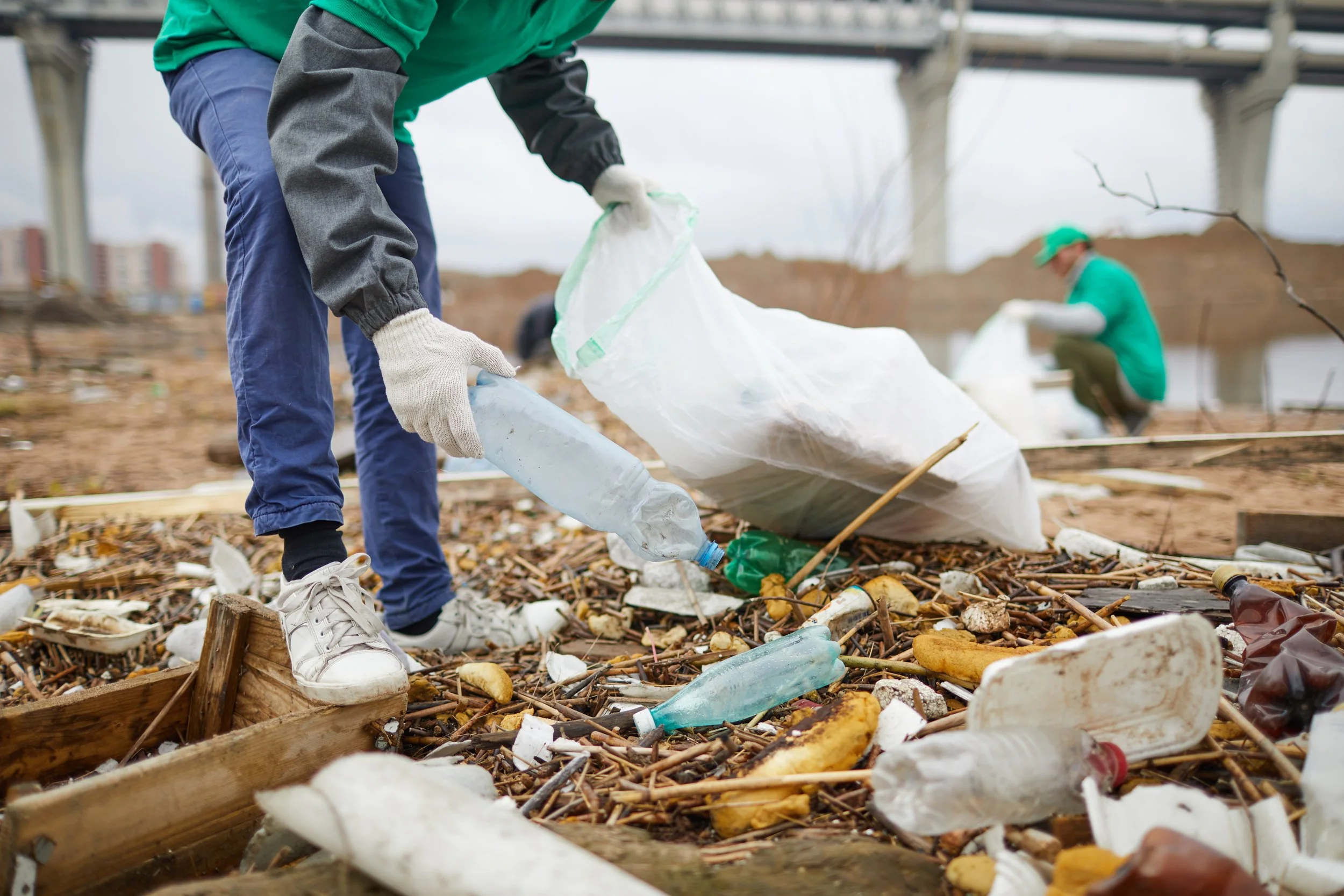
By PressmasterThe literature review examines how peer social comparison can be used to motivate sustainable behavior change with regard to single-use plastics. In contrast, other studies argue that having a solid environmental attitude and belief is most significant to behave sustainably.
The research was conducted for university students to test how social comparison information will impact their motivation and desire to single-use plastic consumption. Participants were given wrong feedback about their behavior with single-use plastic water bottles and learned that their sustainability behaviors were better or worse than the average at their university
This research provides evidence that social comparison information can be used as a way to motivate more sustainable single-use plastic behaviors (Bruchmann et al., 2021).
KEY FINDING AND OPPORTUNITY
😲 The study could not prove the effect of social comparison information
on the participants perceived ability to practice more plastic water bottle sustainability.
💡 Future research can be investigated how people are willing to continue to involve themselves with peer social comparison to identify their desire to change behavior.
METHODS
The experiment was conducted in Google form for seven days. (June 2, 2022- June 9, 2022).
Three participants were asked to share plastic photographs in the I-message group chat whenever they used certain types of single-use plastics; which following;
Plastic cups 2. Plastic bags
After sharing the photographs, they filled out a survey that includes the purpose of the use, their feelings after using the plastics, and the reason for it. In result, 18 responses were recorded.
After, each response was sent to the I-message group chat, leading three participants to see others' feelings and the purpose of the usage.
PARTICIPANT’S PROFILES
ANALYZE
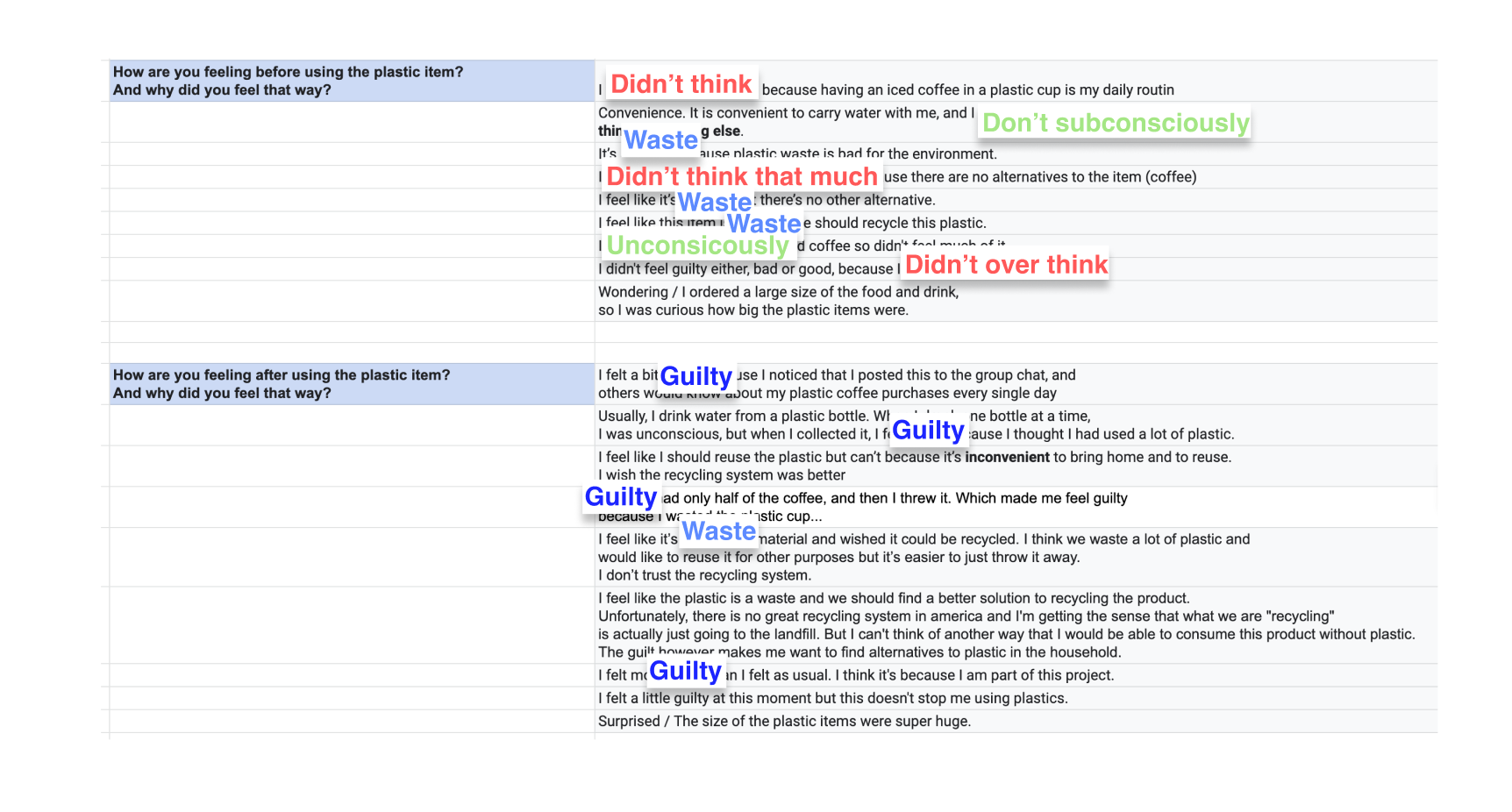
Answers I collected First, the collected data was calculated based on frequencies to identify the contribution of each category. Based on the content, sources were grouped into the following categories;
Why did you use the plastic item? (Convenience, Protection/Preservation/No alternatives)
How are you feeling using the plastic item? (Feeling Guilty, Not guilty, Neutral)
Why did you feel that way? (Waste, Recycle, It’s part of the project)
Why did you feel that way? (Subconscious, No alternatives, Convenience)
FINDINGS
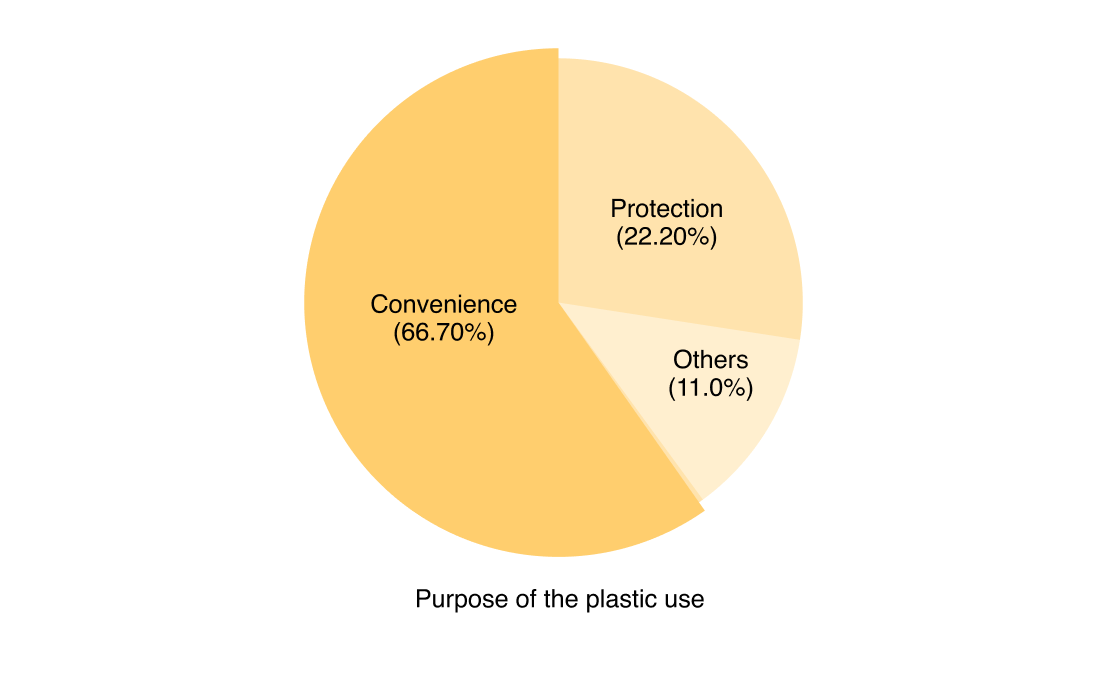
Figure 1.The results showed that Convenience is the prevalent reason for plastic usage (Fig 1).
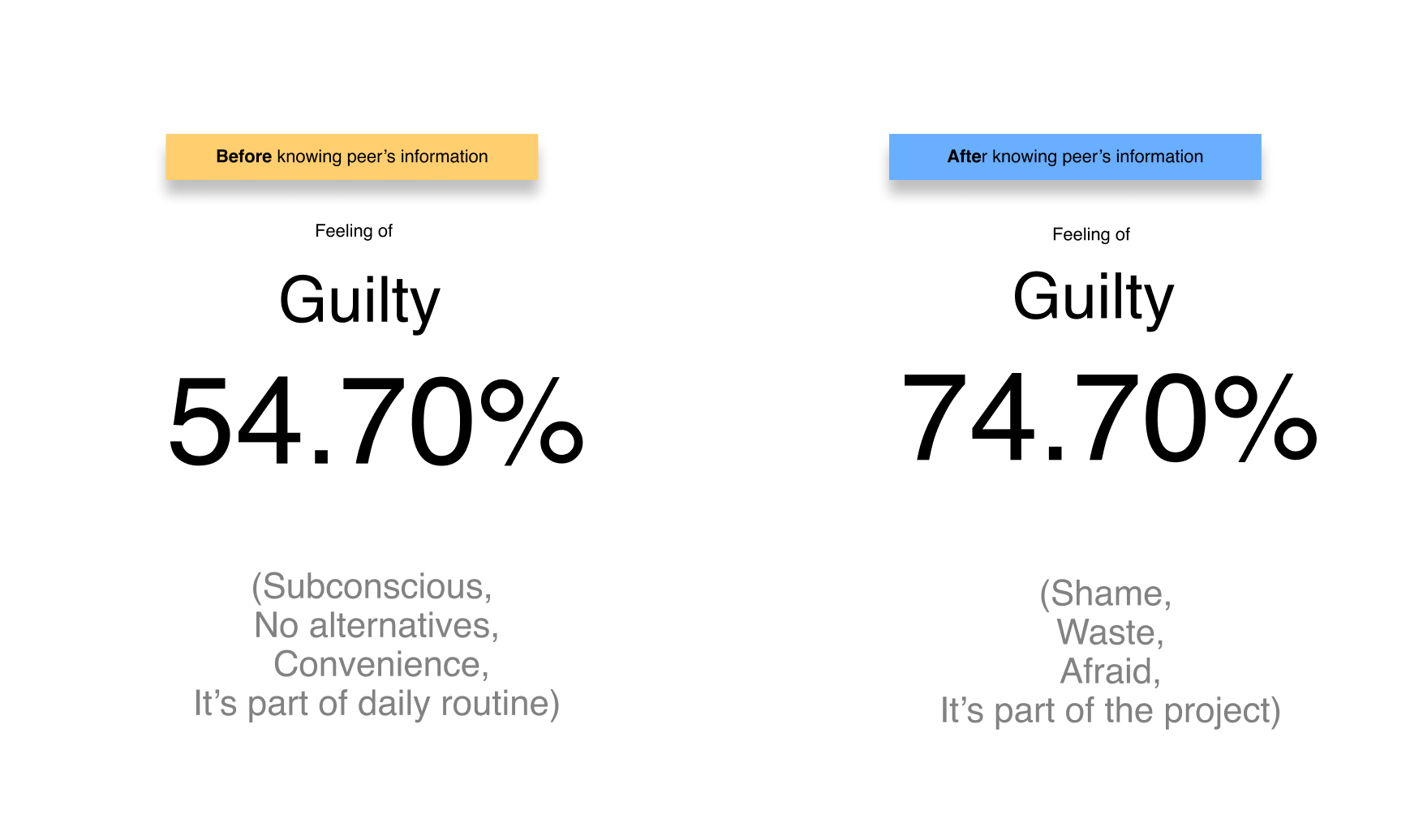
Figure 2.The results showed that 54.70% participants described feeling of guilty before knowing the peer’s information. But, after knowing the peer’s information, feeling of guilty increased to 74.70% (Fig 2).
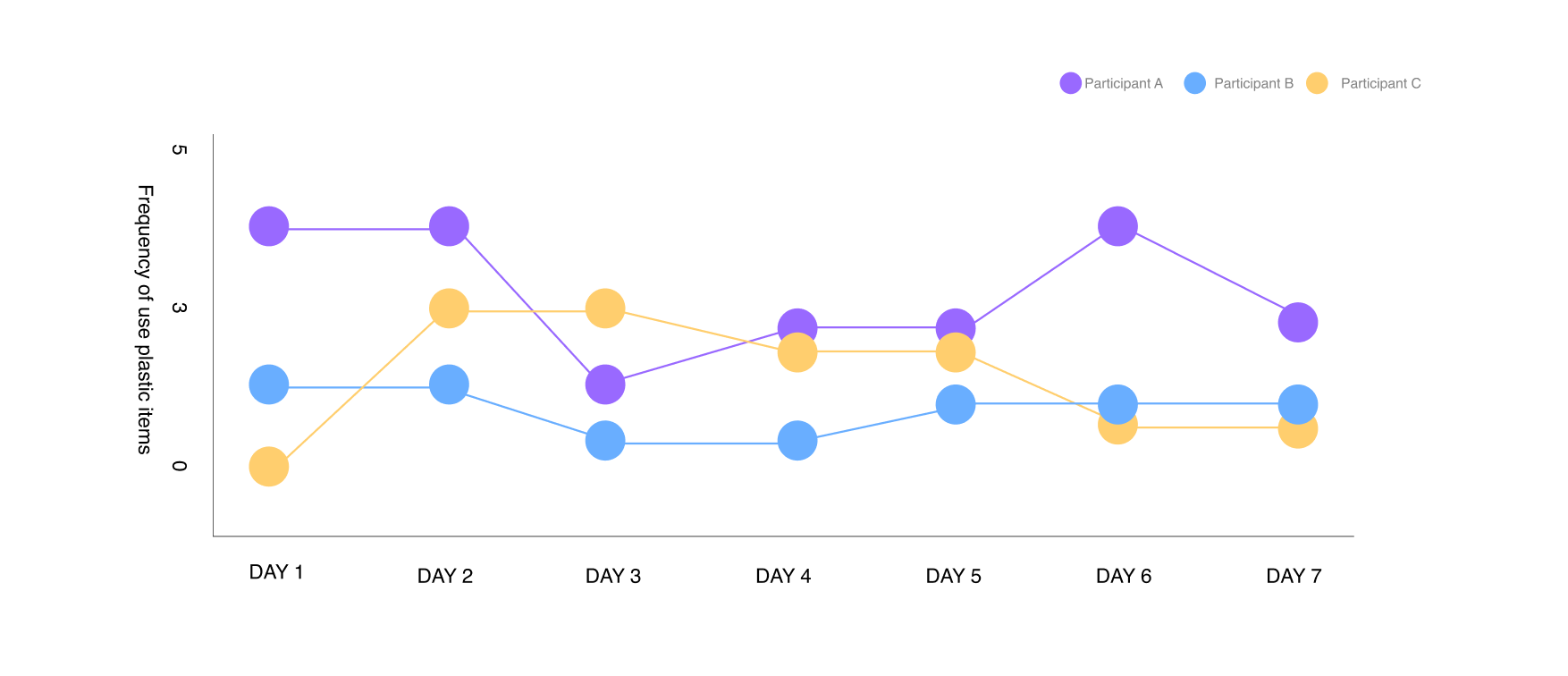
Change of plastic use during the study Figure 3.This result show change in participants’ plastic usage by sharing plastic photographs in the I-message group chat whenever they used certain types of single-use plastic. Even though Participant A who used plastic items most responded feeling of guilty was the prevalent emotion, her plastic usage hasn’t reduced. Likewise, Participant B and C’s plastic usage has not prominently changed.
LIMITATION
USER INTERVIEW
What causes poor sleeping and coping skills for the difficulty of sleep?
Next, I wanted to listen to people who are suffer from Insomnia. I gathered five participants who are suffer from insomnia. I gathered qualitative data then organized it through affinity mapping. Mainly, I focused what’s the causes of poor sleeping and how they are coping with it.
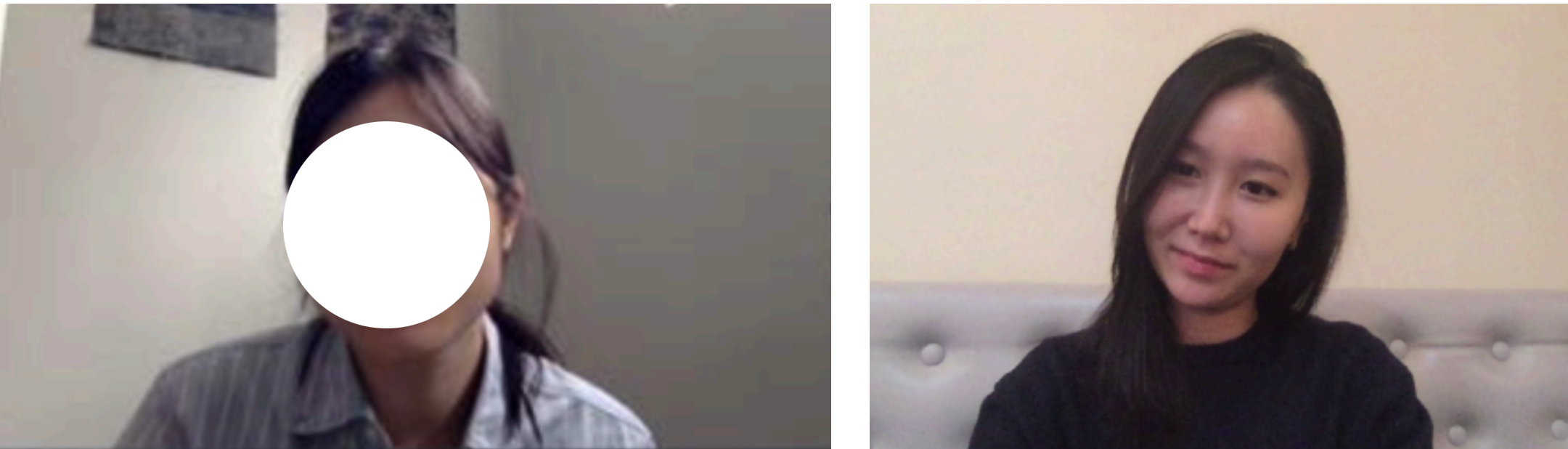
To gather their sleep stories, I asked few questions
1. What does quality sleep means to you?
2. What’re your bad habits that affect your sleep?
3. What do you do when you can’t sleep?
4. What’s external factors distrubing your sleep?
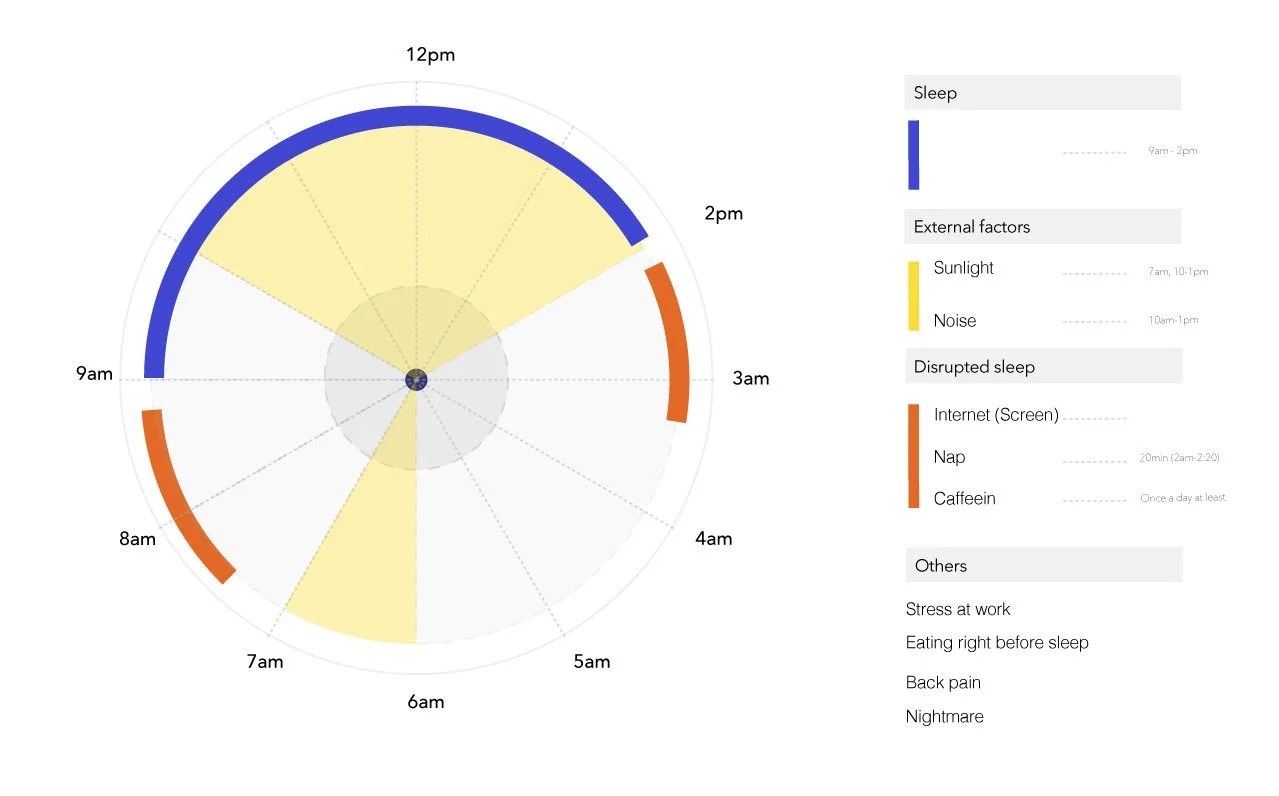
John’s sleep journey mapI’ve noticed how they have various internal (Stress) and external (Sunlight and Noise..) causes of sleep deprivation.
When interviewee were stressed, they report coping through smartphone use, especially through distracting Social Media apps. In my study, all of the participants report using their smartphones before sleep especially, as a means to escape anxiety or to wind down from the stresses of their day.
“I wish my sleep routines are fun’’
One of the interesting responses is they all have different sleep practices. Some of them do stretching and others are listening podcast to wind-down and sleep.
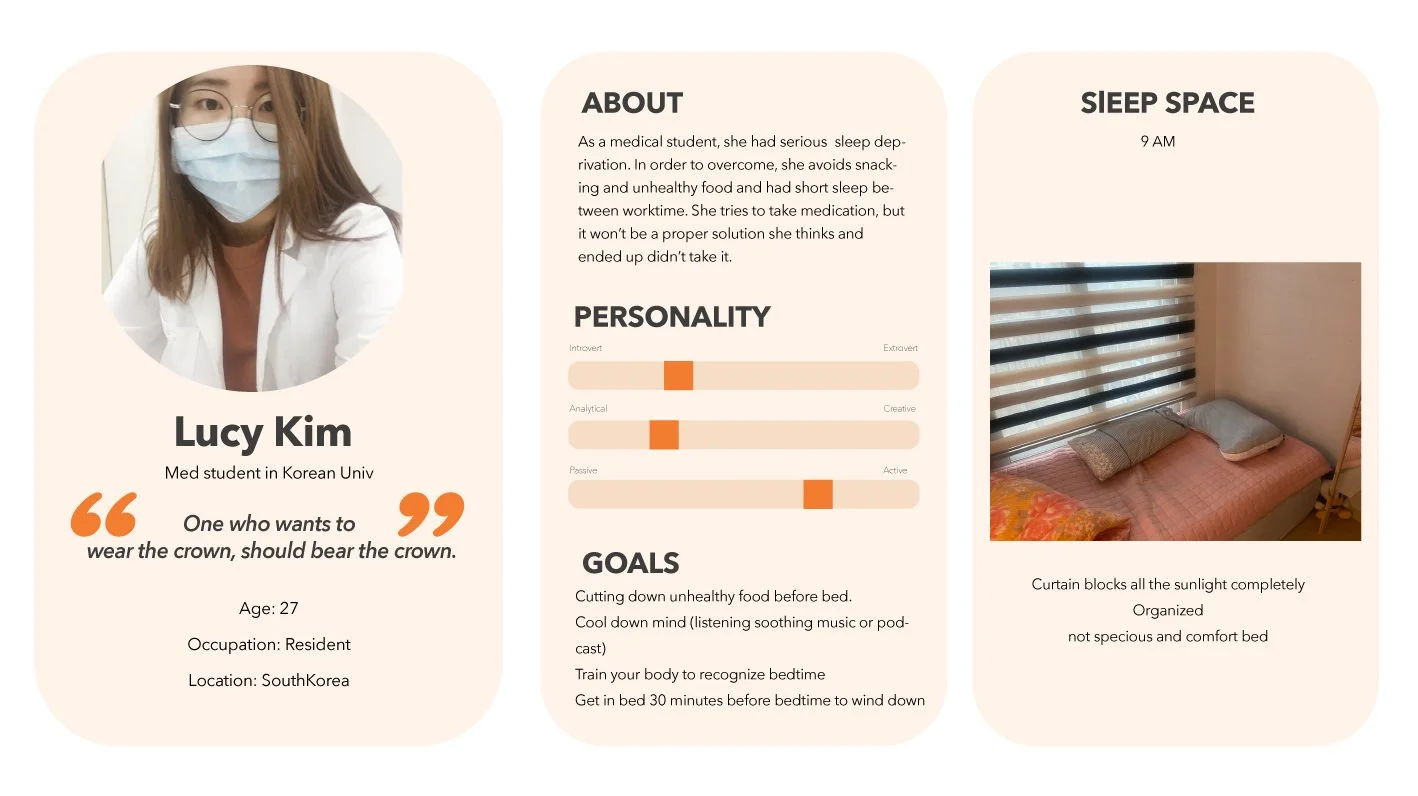
Lucy’s Persona 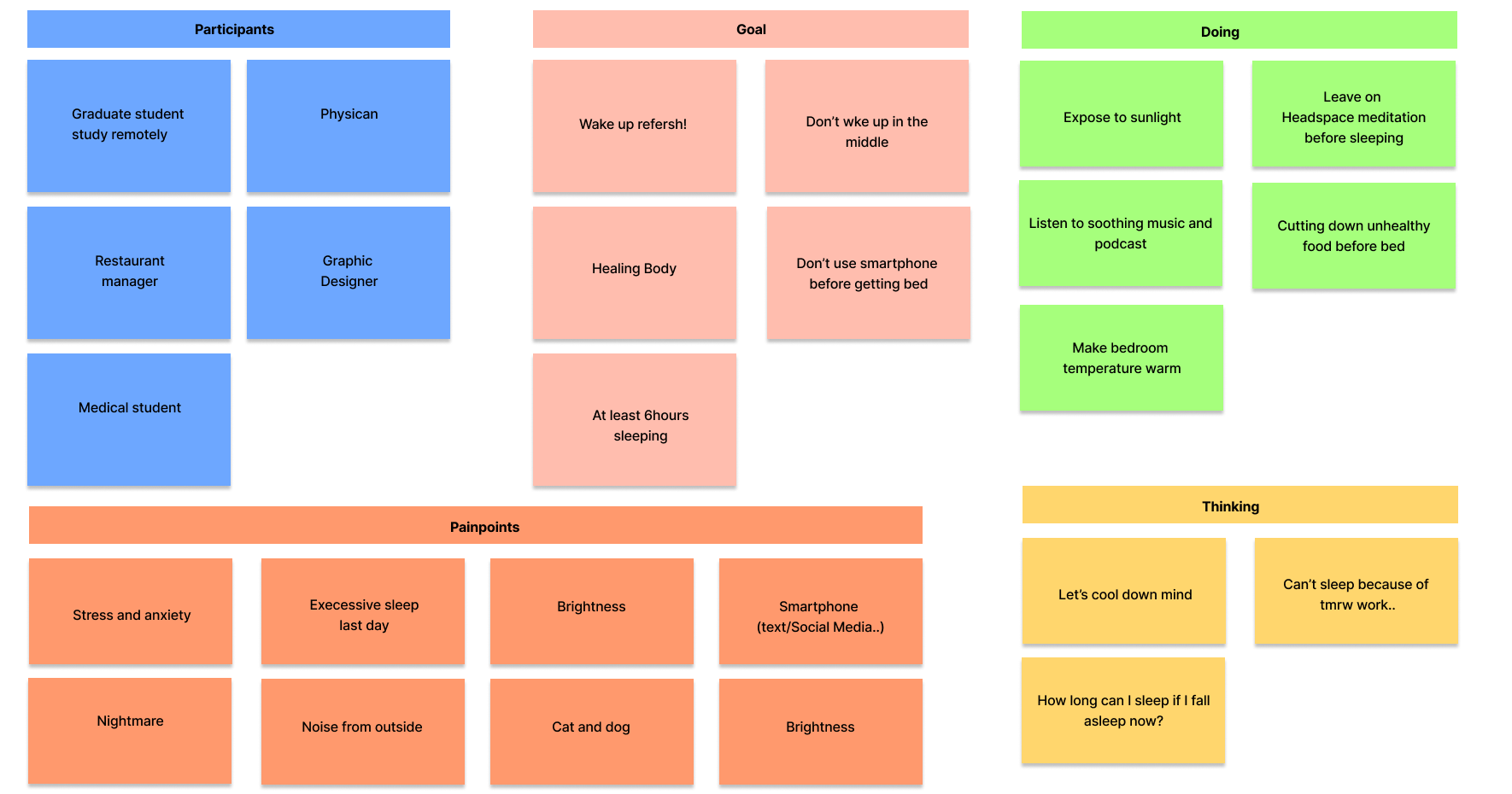
Affinity diagram I also asked to gather interviewees’ bedroom photographs while asking about their ideal bedroom environment. Some people prefer completely mute settings, while others prefer ambient white noise throughout sleep. They stated that they believe the bedroom environment affects sleep but don’t know what a perfect bedroom environment is.
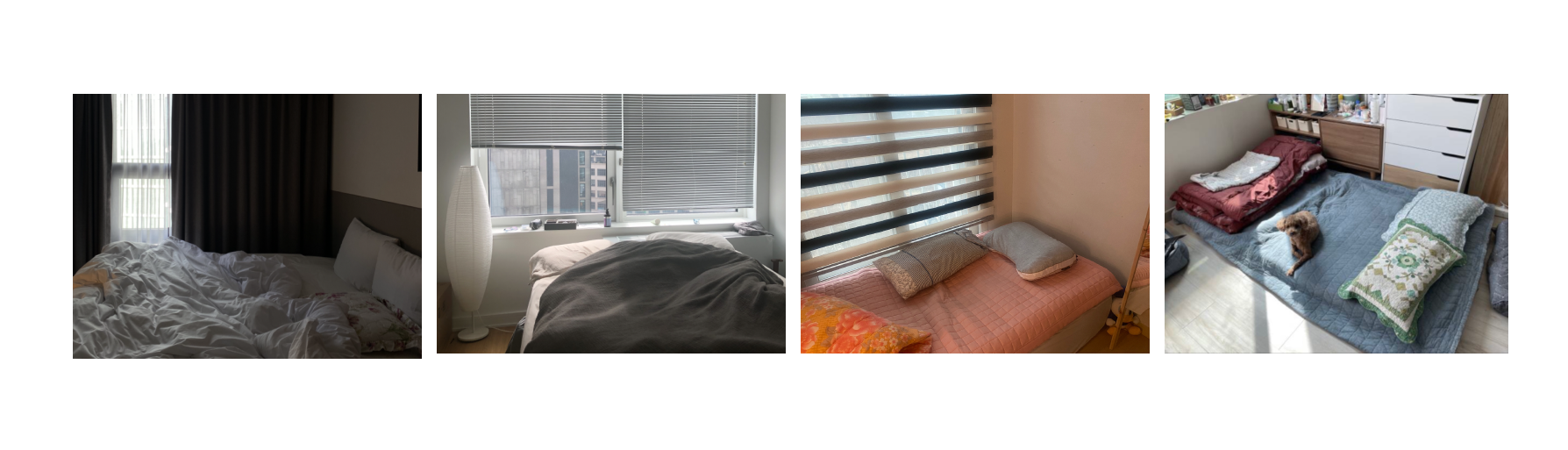
Interviewee’s bedroom photographsKEY INSIGHTS
Bedroom setting and sleep rituals highly affects interviewee’s sleep
After conducting countless user interviews, I found they have varied sleep routines and environments and want to find improvement in their sleep hygiene. And I found interviewee explained the causes of insomnia are mostly stress for various reasons. Thus, optimizing environmental factors should be an effective solution instead of focusing on an individual’s stress solution. To discover opportunities, I divided insights into three following categories.
-
People have various sleep environment preferences and their sleep quality is highly affected by those. Some people prefer completely mute environments, while others prefer ambient whitenoise throughout sleep. Interestingly, some of them spray scents on their bed to faciliate sleep!
-
Humans are creatures of habit. Like any other routine, bedtime routines establish habits that help their brains to recognize when it’s bedtime. People have varied sleep routines and want to find improvement in their sleep hygeine.
-
I found that when participants were stressed, they report coping through smartphone use, especially through distracting Social Media apps. In my study, all of the participants report using their smartphones before sleep especially, as a means to escape anxiety or to wind down from the stresses of their day.
IDEATION
The Goals for this app are:
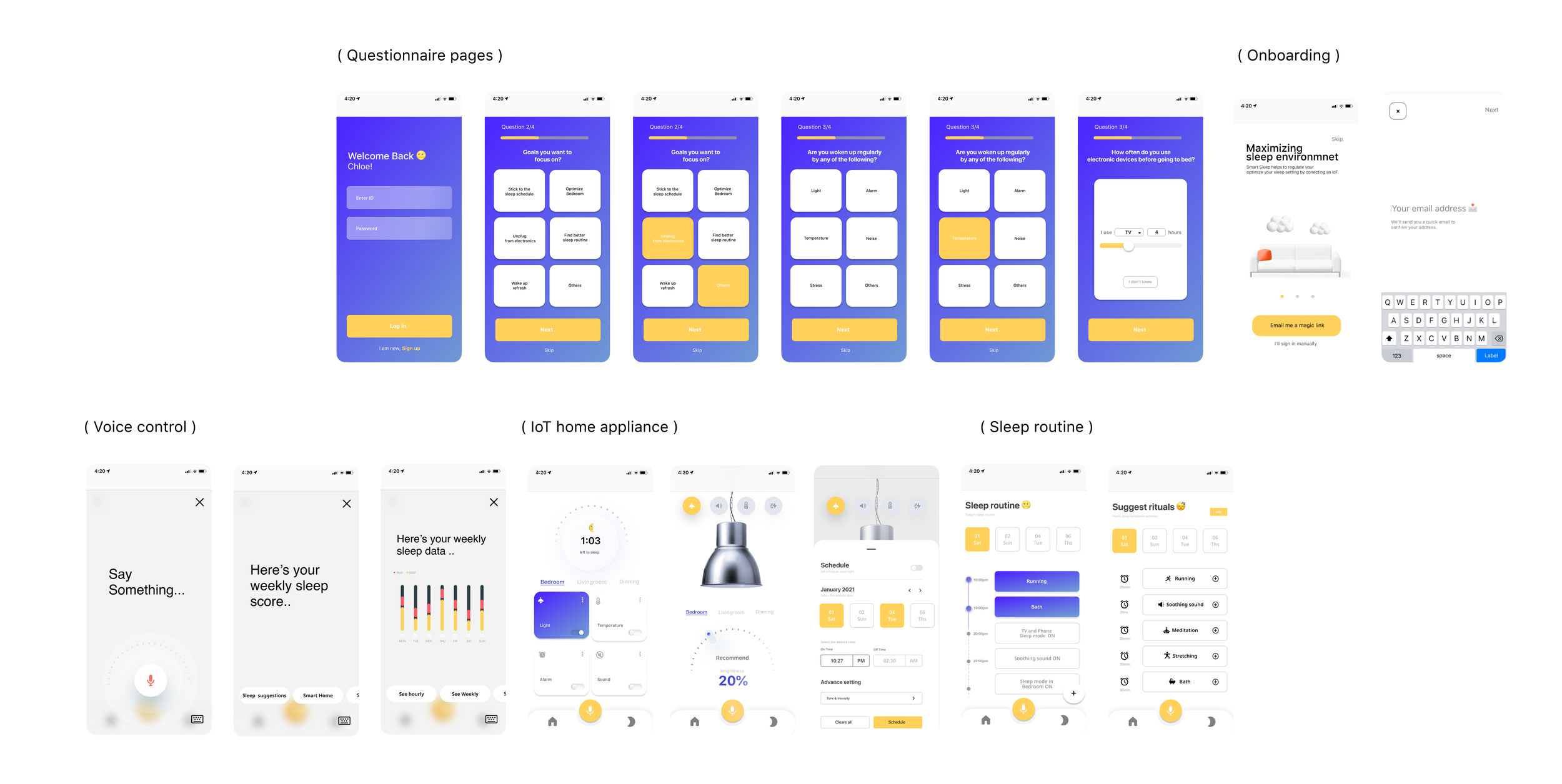
01. Optimize bedroom environment through IoT solution
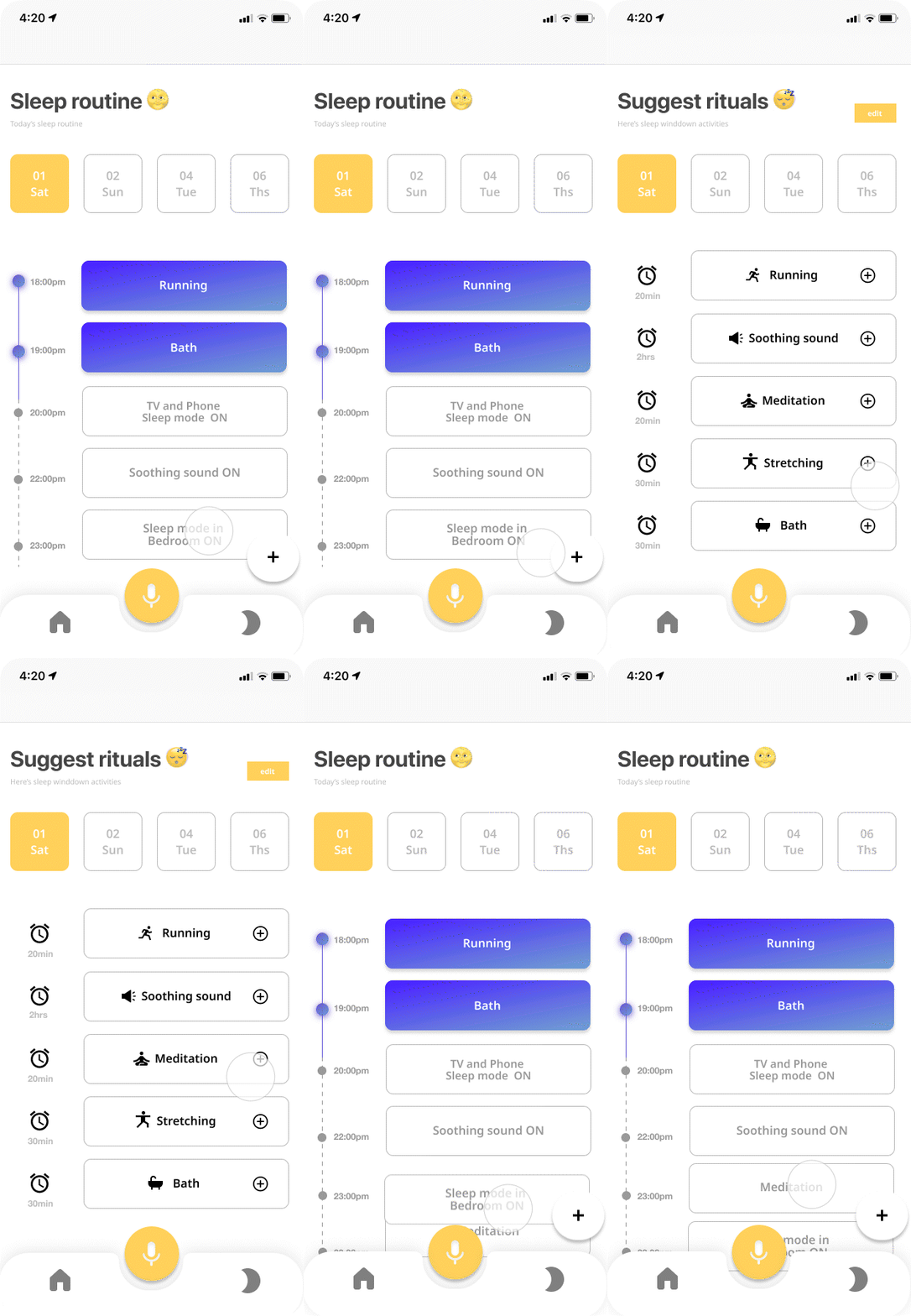
02. Make sleep routine consistent and customizable
03. Reduce smartphone usage
The Features to achieve the goals:
01. Personalize guidance on sleep environment based on the nights that user had the best quality sleep.
02. Suggesting various sleep routines sleep rituals make it consistent with smartphone and IoT alert.
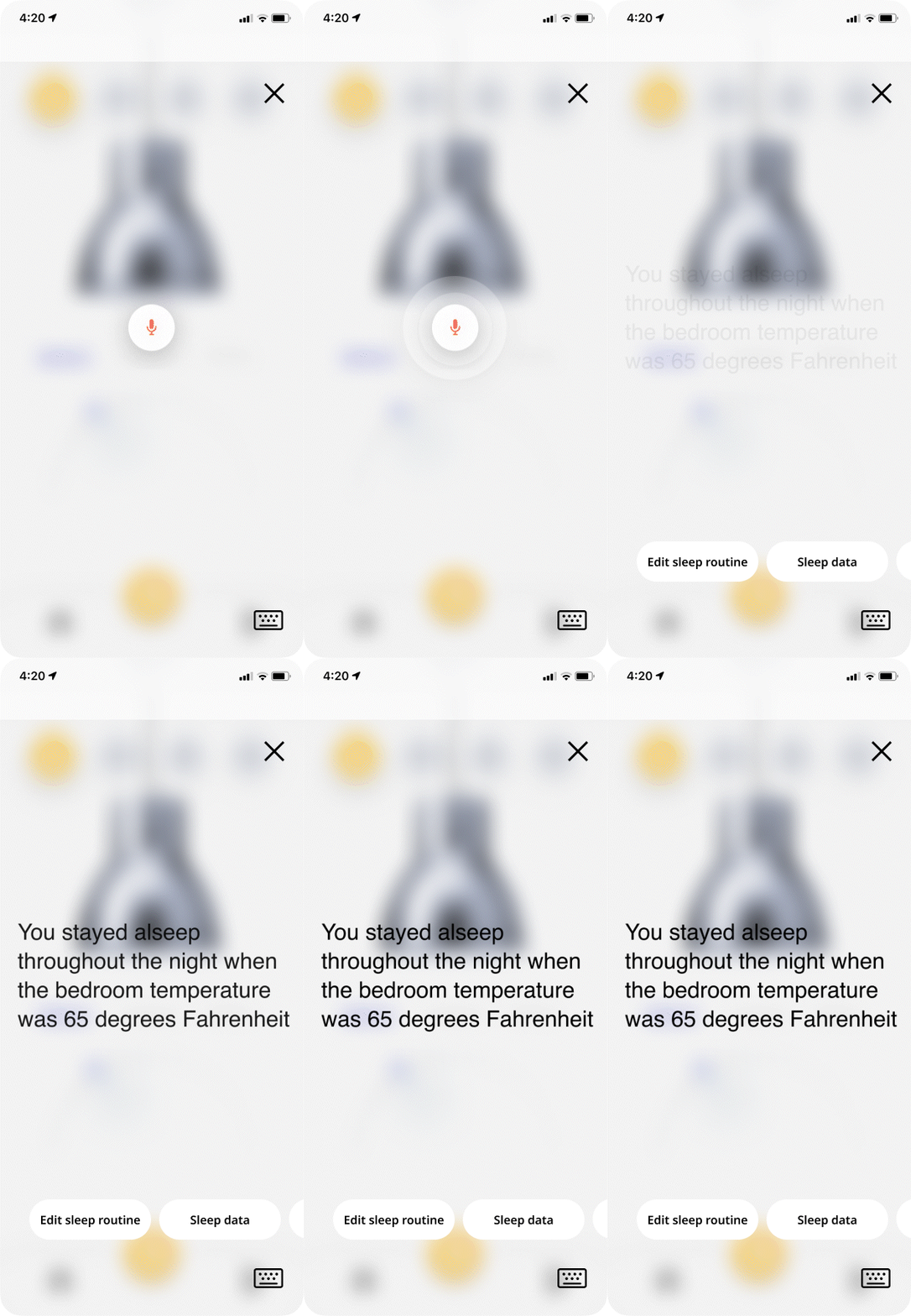
03. Voice control feature helps less rely on a visual phone screen.
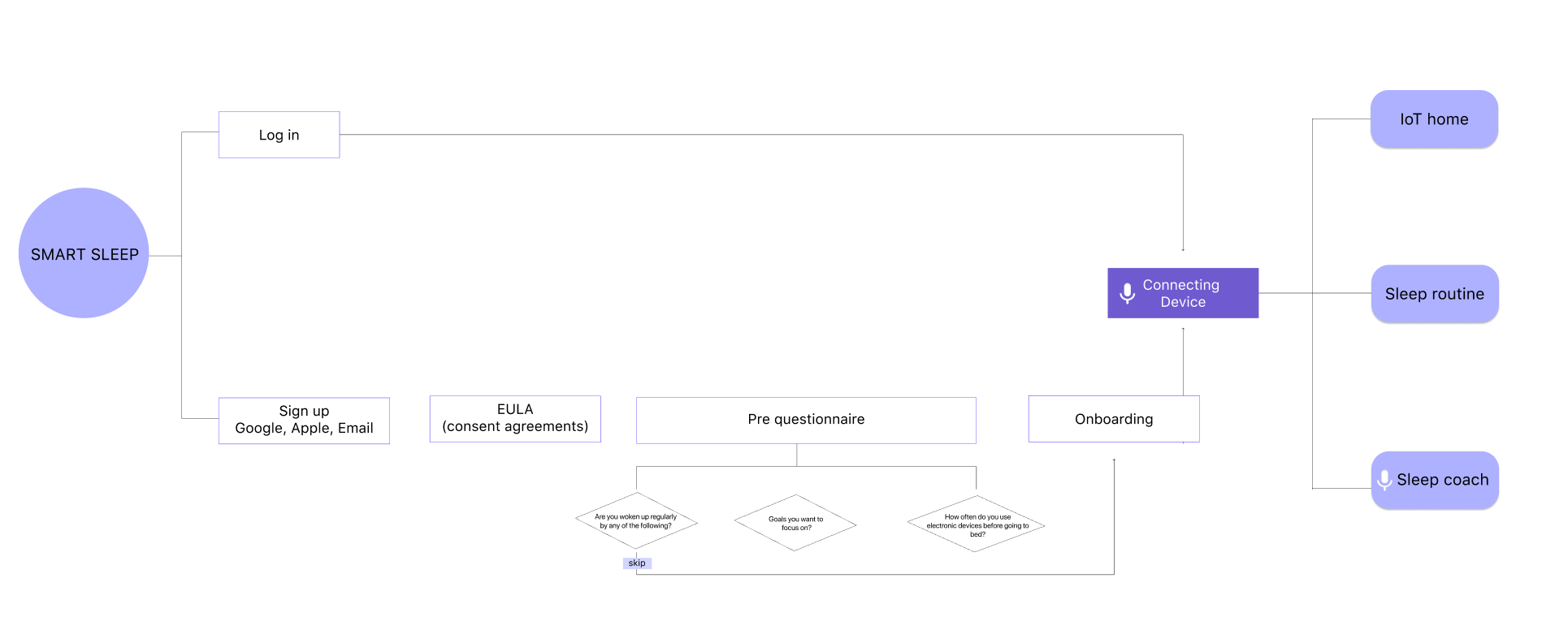
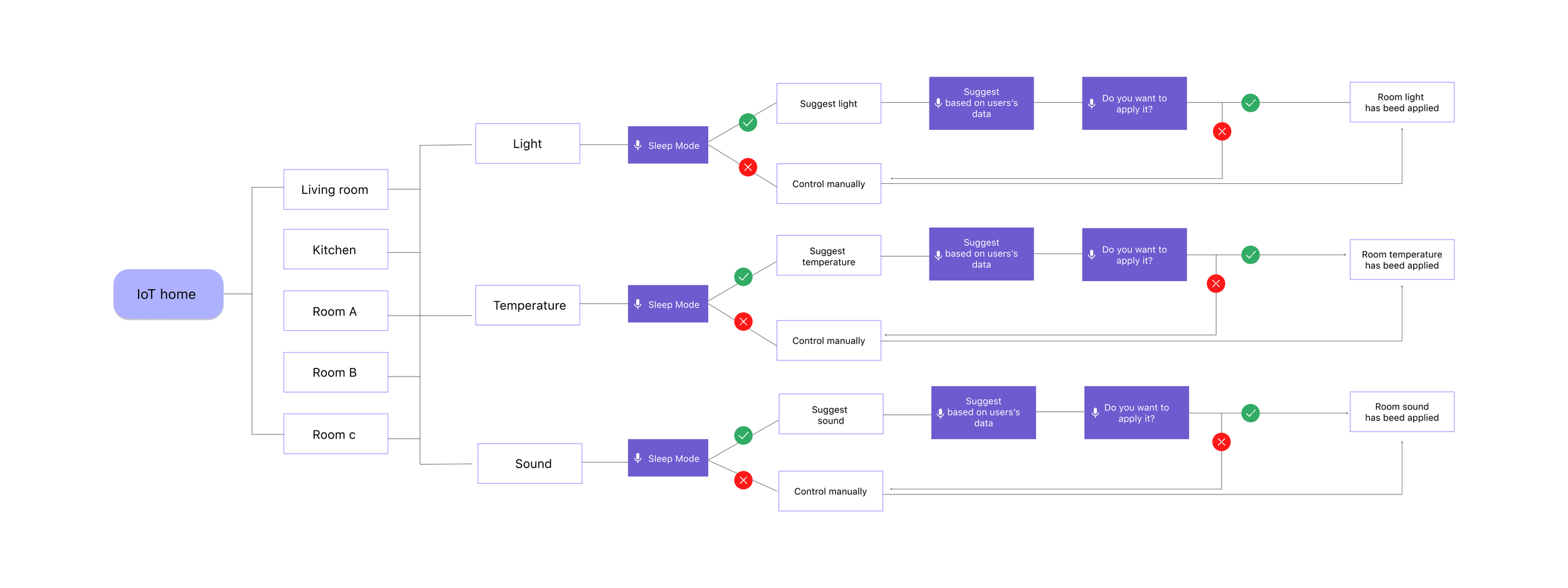
IoT Home journey map (detailed) TESTING + IMPROVEMENTS
Iterative in my design
After created low-fi screen, I continually iterated my design over the span of 2 weeks- with 3 major improvements based on various feedback from 3 other peers + Instructor’s feedback.
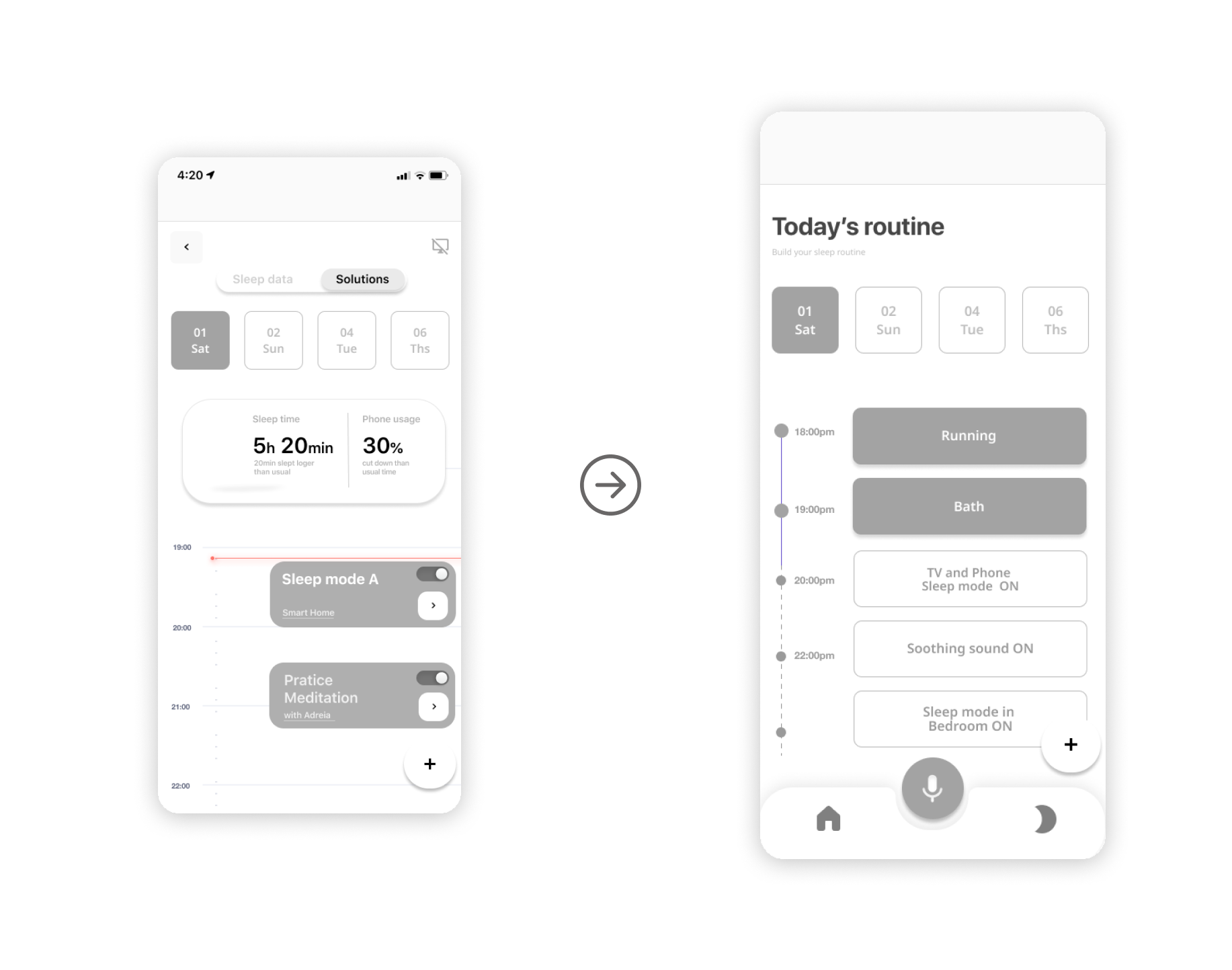
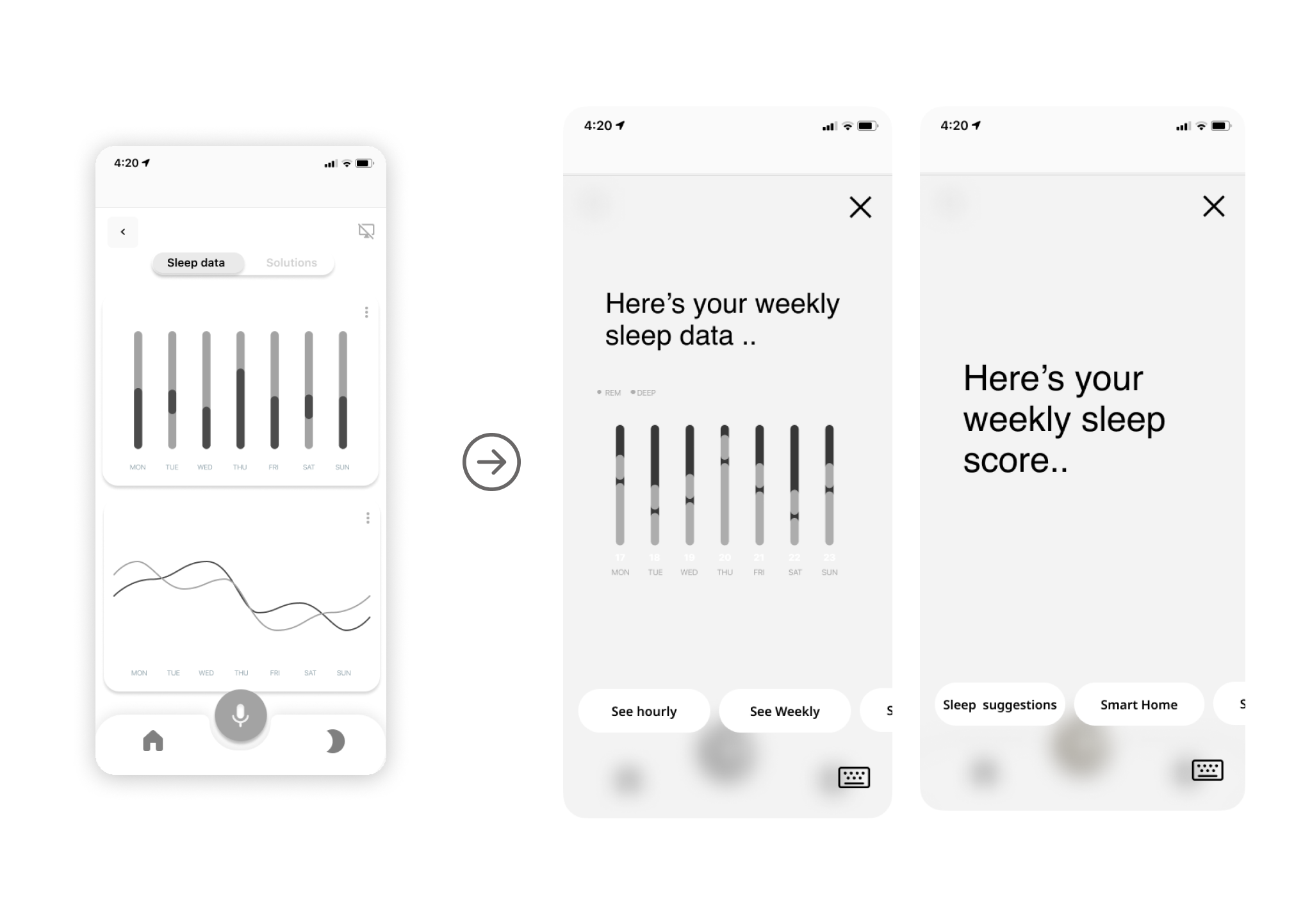
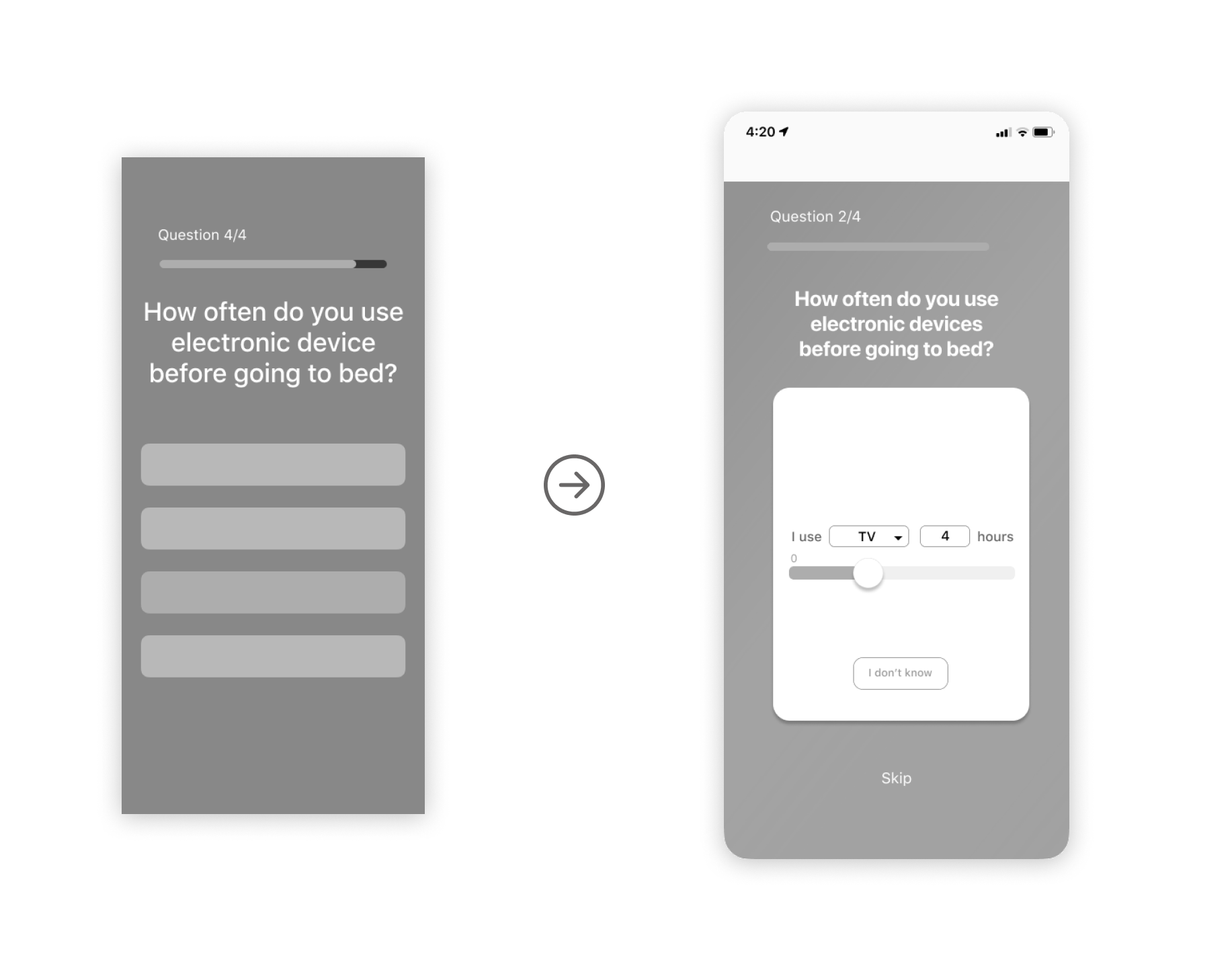
1.Increase Visibility of system status
Based on the peer feedbacks, too many signifiers and information confusing for them to know what's the page about immediately.
Remove Sleep time and Phone usage sections that disrupts user’s cognitive load.
2. Voice Control
Sleep data page isn’t intuitive to understand. Tracking sleep data feature is already existing in market.
Upon feedbacks, Voice control should be a central feature.
Incorporate tracking sleep data into voice control.
3. User control and freedom
“Users often perform actions by mistake. They need a clearly marked emergency exit to leave the unwanted action without having to go through an extended process ( Nielsen 1994)”.
Adding I don’t know button and skip button allows users to control the system.
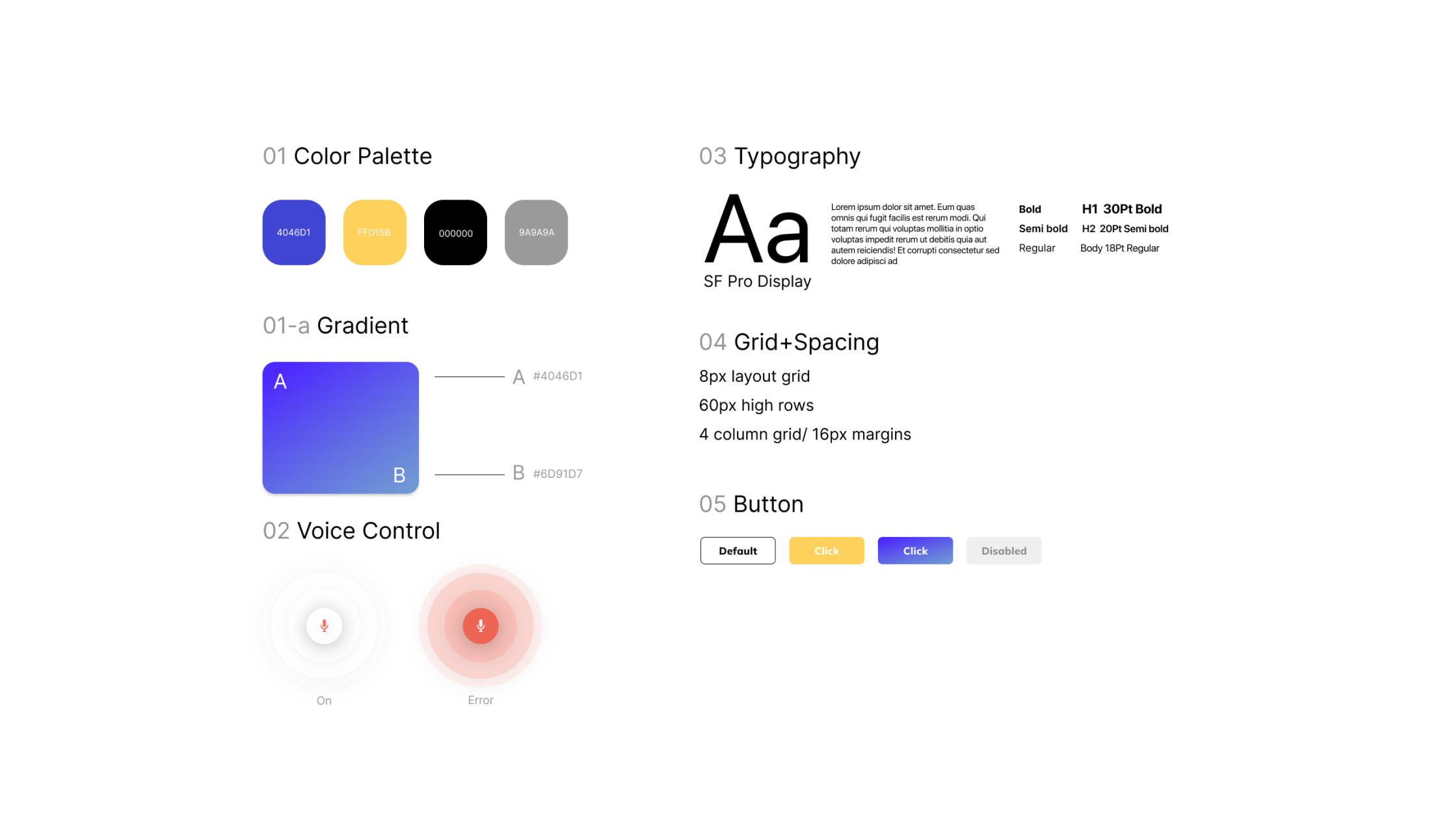
THE STYLE GUIDE
Futuristic, comfortable, appealing & mindful
I created some mood boards, mood boards containing images, structures, patterns fonts, and icons to represent the mood of our brand attributes. designing the mood board was followed by creating a survey to find out which of them worked best for future users. Upon the result, I created the style guide.
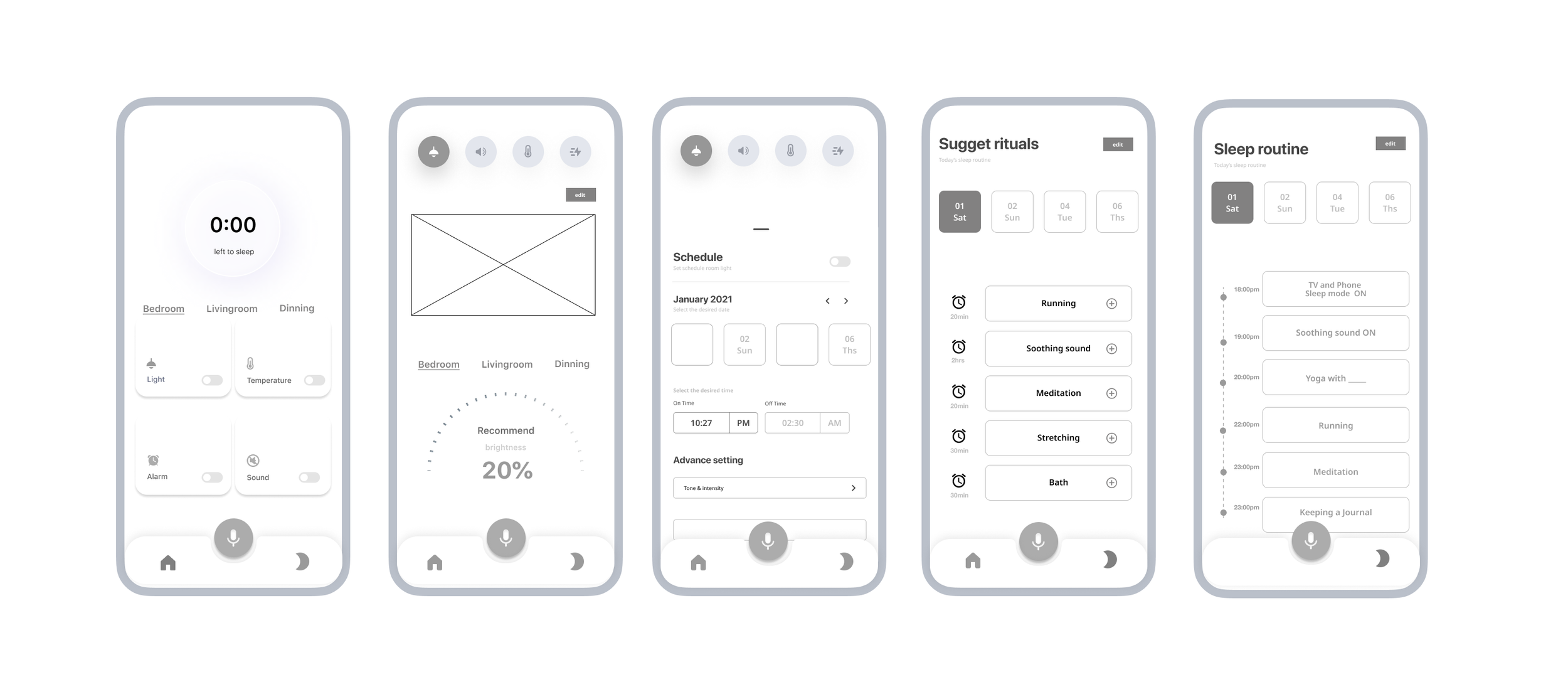
LO-FI WIREFRAME
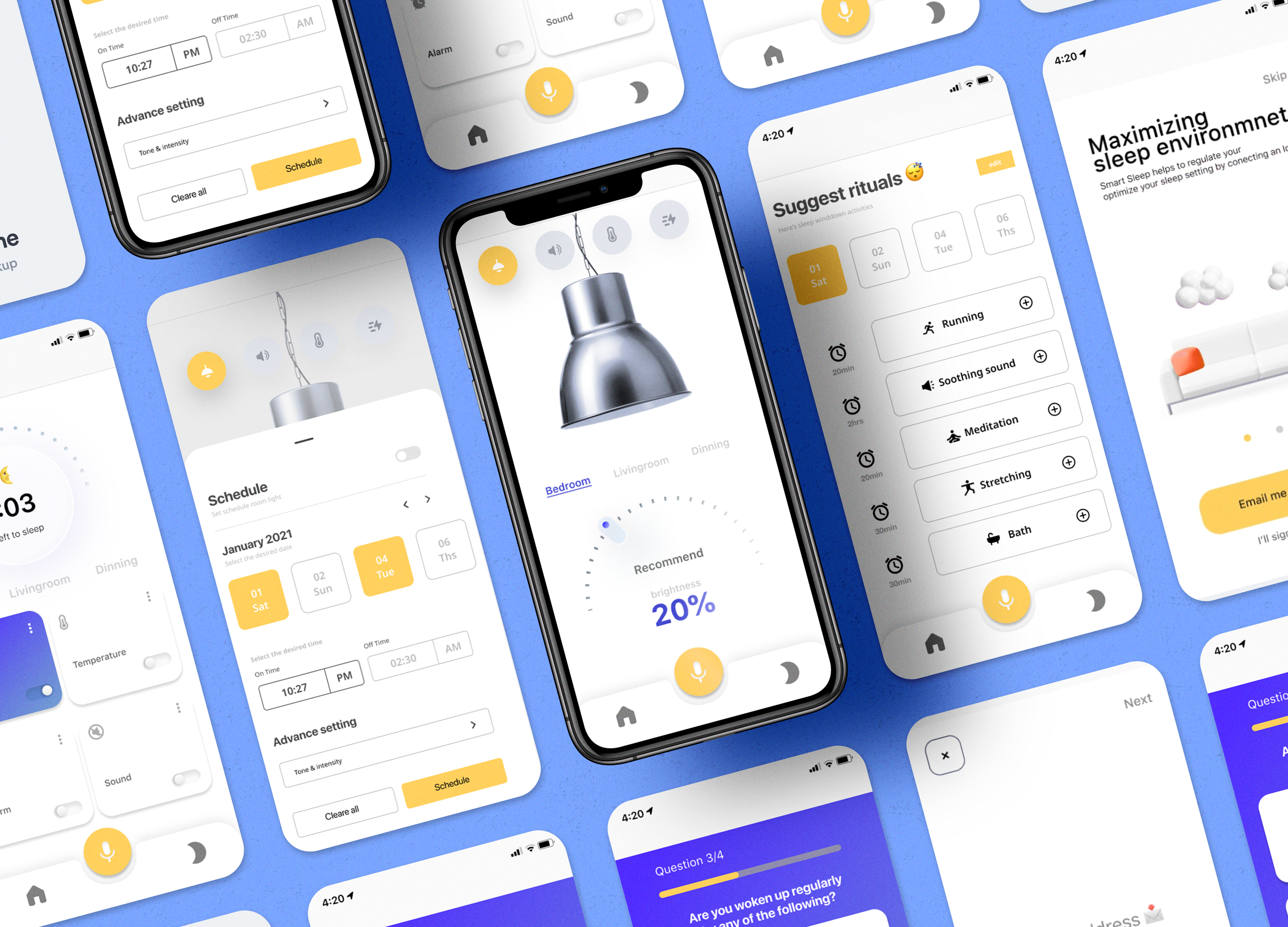
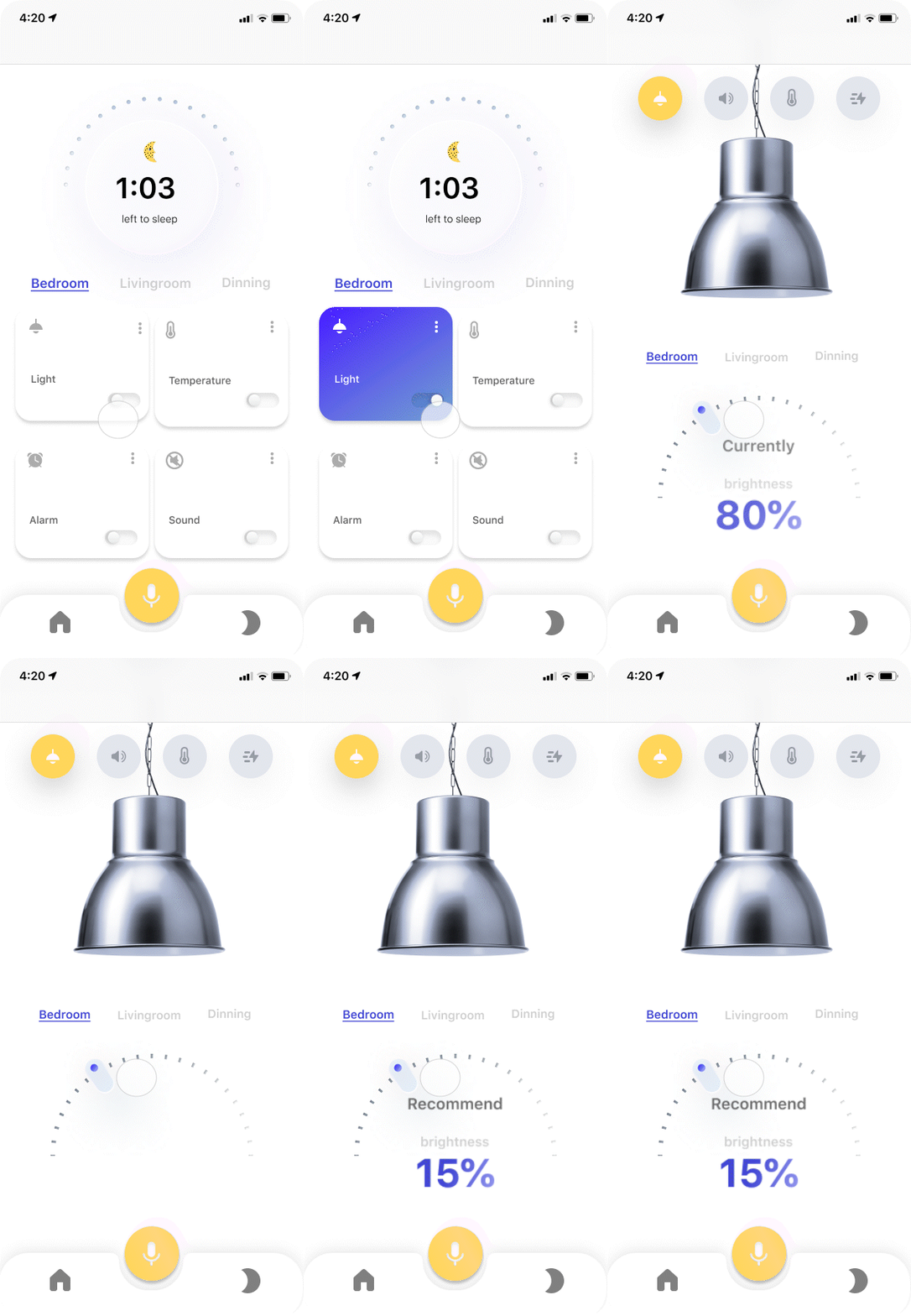
FINAL PAGE
WHAT I LEARNED..
Iteration is the key to design success!
It was the first official UX project, and I am happy about the result so far. It was an exciting project as it provided real value, user research, and detailed interaction works. However, as I work solo, there are challenging to find out pain-points and opportunities. I researched where my design solution fits into the user's life, asking questions like 'What sleep means to you?' 'What do you use the phone on the bed?' Undertaking user research reveals design challenges. Through this project, I learned how to come up with good questions, avoid ending in yes/no responses, and take a broad view from the start.
I think reducing the smartphone usage by voice access commands feature isn’t persuasive so If I have a chance to improve this project, ideation should be iterated. I also found there isn't a perfect research method, especially on the first try. This project made me realize how much I love design (problem solving) and how I won’t stop creating 🥰.